NDK, Administrative building, 9th Floor, 1463 Sofia, Bulgaria


Cannes 2026: Between Art and the Algorithm
- On 18/05/2026
- AI in advertising, artificial intelligence in film, Cannes 2026, Cannes Film Festival, creative industry, creator economy, digital creators, film industry, future of cinema, Meta Ray-Ban glasses, Social-Media, Thelma & Louise poster, креативна индустрия
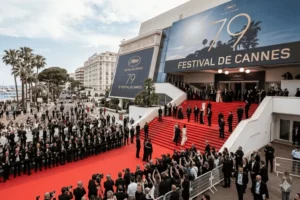
Opening ceremony red carpet at the 2026 Cannes Film Festival in Cannes, France. Photo: Getty Images
Every May, the French city of Cannes transforms into a global stage for cinema, culture, and ideas. From May 12 to 23, 2026, the legendary Cannes Film Festival once again brings together directors, actors, producers, artists, journalists, brands, and technology companies from around the world on the French Riviera. Founded in 1946, the festival has long been much more than a red carpet and the Palme d’Or — it is a place that captures the spirit of its time and often sets the direction for the global cultural and creative industries.
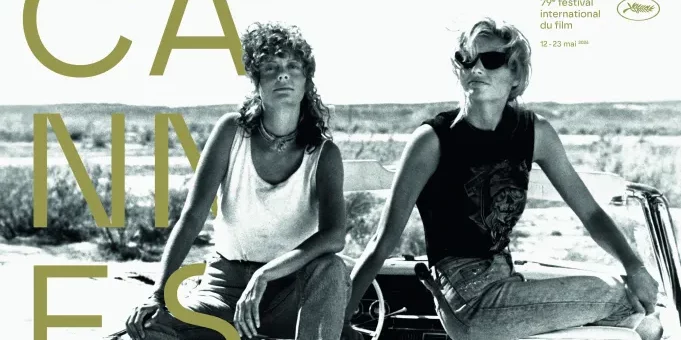
And it is precisely in this space between tradition and transformation that this year’s official poster stands out — a classic frame from Thelma & Louise, which has become an enduring symbol of freedom, friendship, and human emotion. Against this backdrop, the theme of artificial intelligence naturally emerges as both a counterpoint and a continuation of the broader conversation about how authenticity is created and preserved in contemporary art.
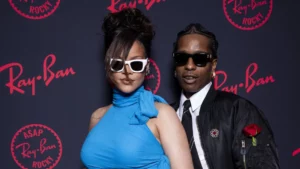
A$AP Rocky&Rihanna at the A$AP Rocky x Ray-Ban party during, Cannes Film Festival in Cannes, France. Photo: Getty Images
Cannes 2026: AI is no longer the future, but the present
This year’s Cannes made it clear that the boundaries between cinema, advertising, digital content, and social media are gradually dissolving. AI is everywhere — from the way films and campaigns are created to how the festival itself is experienced online and in real time. In this context, Meta officially replaced TikTok as the festival’s key partner and used Cannes as a stage to present its vision for the future of entertainment. It is a world where AI, Reels, Threads, immersive technologies, and real-time video intertwine into a single unified digital experience.
Particular attention was drawn to Ray-Ban Meta glasses, with which online creators, directors, and influencers produced content directly from the red carpet. This allowed audiences to experience Cannes not only through the lens of traditional media, but also through the eyes of digital storytellers.
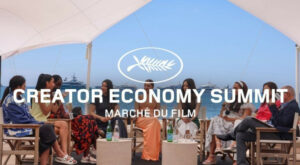
Courtesy of Festival de Cannes / Marché du Film, Photo: Getty Images
The creator economy officially enters the film industry
One of the most important highlights of Cannes 2026 is the first edition of the Creator Economy Summit within the Marché du Film — a clear sign that cinema is becoming increasingly interconnected with the world of digital creators and social platforms. The festival now views online creators not merely as influencers, but as a new generation of producers, directors, and audience owners who are reshaping how content is created and distributed.
A central theme of the forum is how platforms such as YouTube, TikTok, and Instagram are transforming the entertainment industry and building new models for financing, marketing, and audience reach. According to the director of the Marché du Film, Mr. Guillaume Esmiol, digital creators are already building “meaningful bridges” between cinema and online content, while the communities around them are becoming increasingly valuable to the film and advertising industries.
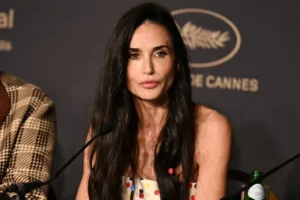
Demi Moore at the 2026 Cannes Film Festival, May 12, 2026. Photo: Getty Images
AI as a creative partner, not a replacement
The biggest debate at Cannes 2026 remains the question: can AI create true art? In an interview with Reuters, Demi Moore commented: “Fighting AI is a battle we will lose.” According to her, artificial intelligence is already an inevitable part of the creative process, but true art remains deeply tied to human emotion, experience, and soul.
A similar philosophical perspective appears in analysis by The Guardian, where AI is described as a technology that will inevitably transform cinema and advertising, but cannot replace human stories, emotional depth, and the creator’s intuition.
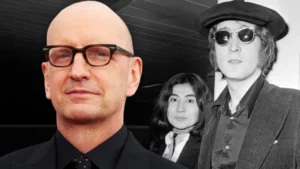
John Lennon: The Last Interview (2026) — Courtesy of Steven Soderbergh
AI in film already
Among the most discussed projects at Cannes 2026 is the documentary John Lennon: The Last Interview by Steven Soderbergh. The production uses AI-generated visualizations to reconstruct archival materials and abstract ideas, sparking serious debate within festival circles. Increasingly, the question is no longer whether AI can be used in cinema, but how far its role should extend — whether it remains merely a tool in the creative process or begins to reshape the very language of filmmaking and storytelling.
At the same time, Meta is demonstrating new AI features for Reels, including automatic dubbing, lip-sync translation, and real-time video translation through its smart glasses. The company presents these technologies as the next step toward a globally accessible content ecosystem, in which videos can reach audiences worldwide almost instantly.
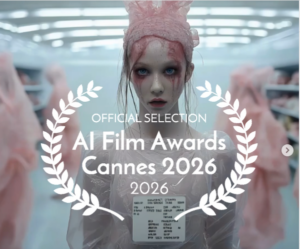
Demanufacture (2026) — Courtesy of Valerio Calsolaro
Fears, ethics, and the loss of authenticity
Despite the enthusiasm surrounding AI, Cannes 2026 also highlighted serious concerns within the industry. The main issues surrounding AI in film and advertising relate to copyright, artist protection, and the spread of deepfake content. There is also growing concern about the risk of losing authenticity, as well as the mass production of content that appears to be generated from a single “AI model,” gradually erasing the human signature in creative work.
According to some festival participants, cinema risks losing part of its unpredictability, boldness, and emotional depth if it becomes overly reliant on automation.
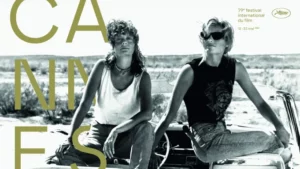
Official Festival de Cannes 2026 poster — Photo Roland Neveu © MGM Studios / Graphic design © Hartland Villa
Cannes 2026: tradition in an era of transformation
The festival is no longer just a cinematic stage, but a meeting point where the film industry, advertising, social media, the creator economy, AI technologies, and global entertainment culture intersect — worlds that are increasingly intertwined and shaping the future of content and communication.
And against this backdrop, the choice of the official Cannes 2026 poster feels deeply symbolic. Instead of a futuristic vision, a digital experiment, or an AI-generated aesthetic, the festival chose a classic, almost minimalist frame from Thelma & Louise — a film that has become a symbol of freedom, friendship, and human emotion. The black-and-white photograph of Geena Davis and Susan Sarandon does not rely on visual noise, effects, or technological display. It relies on something far more powerful — story, character, and authenticity.
In a world where technology can increasingly recreate images, styles, and emotions, art remains that mysterious presence which cannot be replicated. And the true creator is the one who can recognize it, illuminate the story beyond the effect, and give it wings to reach others. That is why the most powerful ideas do not follow models — they remain alive through their uniqueness, quiet courage, and an unforced, enduring sense of beauty and aesthetic truth.